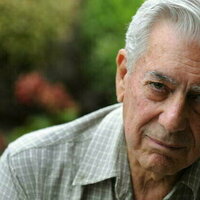


Peruvian authorities on Monday declared a day of mourning with flags to fly at half mast on government buildings following the death of the Nobel literature laureate Mario Vargas Llosa.
The essayist and author of celebrated novels as The Time of the Hero and Feast of the Goat died onSunday. He was 89.
"It is with deep sorrow that we announce that our father, Mario Vargas Llosa, passed away peacefully in Lima today, surrounded by his family," read a letter signed by his children lvaro, Gonzalo and Morgana, and posted by lvaro on social media platform X.
"His departure will sadden his relatives, his friends and his readers around the world, but we hope that they will find comfort, as we do, in the fact that he enjoyed a long, adventurous and fruitful life, and leaves behind him a body of work that will outlive him."
Jorge Mario Pedro Vargas Llosa was born on 28 March 1936 into drama in the southern city of Arequipa.
His father, Ernesto Vargas Maldonado, had left before the child's birth and to avoid public scandal, his mother, Dora Llosa Ureta, took her son to Bolivia where her father was the Peruvian consul in Cochabamba.
Vargas Llosa described his early life as traumatic. He was pampered by his mother and grandmother in a large house with servants and it was not until he was 10, after the family had moved to the coastal city of Piura that he learned that his father was alive.
His parents reconciled and the family moved to the capital, Lima.
Military academy
Vargas Llosa described his father as a disciplinarian who viewed his sons love of the French novelist Jules Verne and writing poetry as a path to poverty.
After failing to enrol his son in a naval academy, Maldonado sent the would-be wordsmith to Leoncio Prado Military Academy.
Already a part-time crime reporter for La Crnica newspaper in Lima, he entered San Marcos University in Lima to study literature and law. "The former as a calling and the latter to please my family, which believed, not without certain cause, that writers usually die of hunger," Vargas Llosa later quipped.
Peruvian Nobel winner Mario Vargas Llosa joins French Academy
After earning his literature degree in 1958 he did not submit his final law thesis Vargas Llosa won a scholarship to pursue a doctorate in Madrid.
Vargas Llosa published his first collection of stories The Cubs and Other Stories in 1959. He made his mark in 1963 with The Time of the Hero, a book that mined his experiences at the military academy.
A thousand copies of the novel were burned by military authorities inPeruwith some generals calling the book false and Vargas Llosa a communist.
Subsequent novels such as Conversation in the Cathedral in 1969, cemented his reputation and established him in the vanguard of the so-called Boom, or new wave of Latin American writers alongside Gabriel Garca Mrquez and Carlos Fuentes.
Intense connection
Vargas Llosa drew much of his inspiration from his Peruvian homeland but preferred to live abroad, residing for spells each year in Madrid, New York and Paris.
His early novels revealed a Peruvian world of military arrogance and brutality, of aristocratic decadence, and of Stone Age Amazon Indians existing simultaneously with 20th-century urban blight.
"Peru is a kind of incurable illness and my relationship to it is intense, harsh and full of the violence of passion," Vargas Llosa wrote in 1983.
Biopic explores the life and legacy of Frantz Fanon, a century after his birth
After 16 years in Europe, he returned in 1974 to a Peru then ruled by a left-wing military dictatorship. "I realised I was losing touch with the reality of my country, and above all its language, which for a writer can be deadly," he said.
In 1990, he ran to become president of a country that was in the grip of hyperinflation and a Maoist guerrilla insurgency. But he was defeated by the university rector, Alberto Fujimori.
Vargas Llosacontinued publishing articles in newspapers and magazines, most notably in a twice-monthly political opinion column titled Piedra de Toque (Touchstones) that was printed in several newspapers.
He gradually veered from his communism-linked past to become a fierce defender of personal and economic liberties.
Accolades
Vargas Llosa also used his literary talents to write several successful novels about the lives of real people, including French Post-Impressionist artist Paul Gauguin and his grandmother, Flora Tristan, in The Way to Paradisein 2003 and 19th-century Irish nationalist and diplomat Sir Roger Casement in The Dream of the Celtin 2010.
His last published novel was Harsh Times in 2019 about a US-backed coup detat in Guatemala in 1954.
Interview: Tanzanian-born novelist Abdulrazak Gurnah, a Nobel laureate
HisNobel Prizein 2010 came 51 years afterThe Cubs and Other Stories.The Nobel committee said the accolade was anaward for his cartography of structures of power and his trenchant images of the individuals resistance, revolt, and defeat.
RecallingVargas Llosa's 89th birthday a fortnight ago at Morgana's home,lawyer and close friend, Enrique Ghersi, said: "He spent it happy. His close friends surrounded him, he ate his cake, we joked that day that there were still 89 more years to go. He had a long, fruitful, and free life."
Vargas Llosa's children said there would no formal public ceremony.
Originally published on RFI