

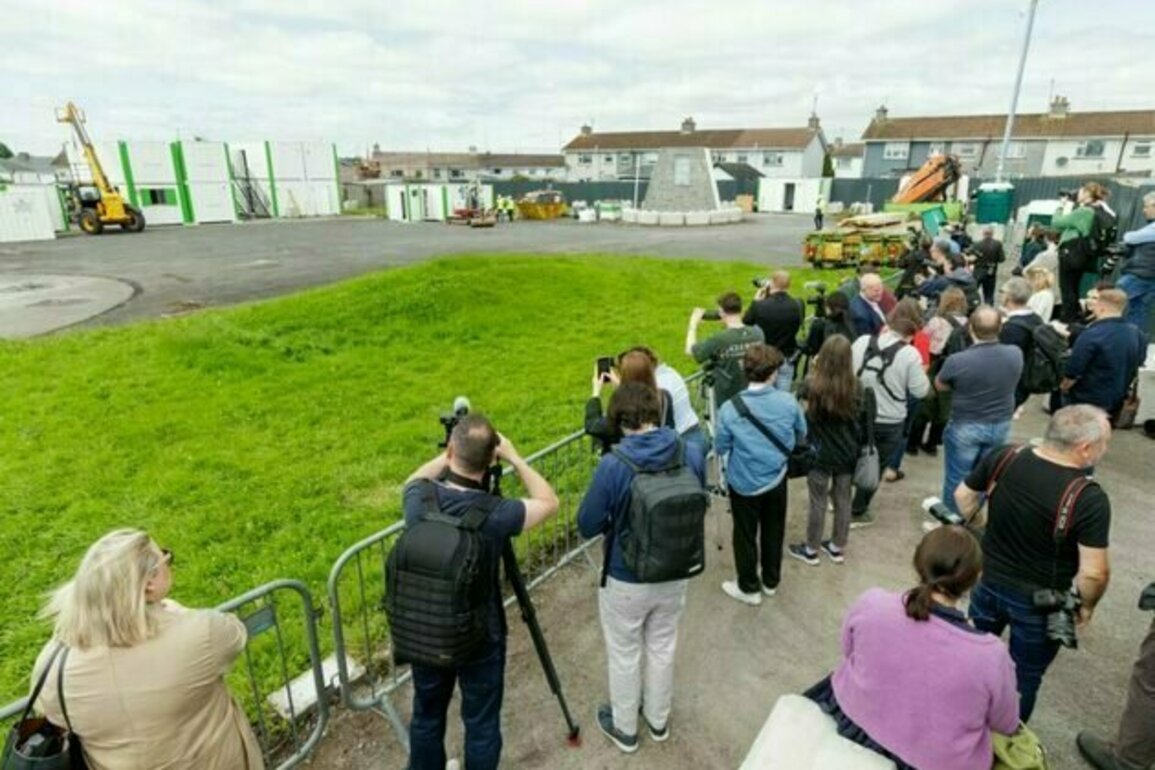
(CN) - Excavation began on Monday to exhume the remains of hundreds of babies and children believed to have been buried inside a sewage tank at the site of a former church-run institution for unwed mothers and their children near Galway, Ireland.
Ground was broken Monday morning at the site of the former St. Mary's Mother and Baby Home in the town of Tuam. The Irish government set up a team of Irish and international forensic experts to retrieve and identify the remains.
The site in Tuam has been at the center of a yearslong scandal over the Roman Catholic Church's treatment of unwed mothers and their babies in its care during much of the 20th century.
The scandal exploded in 2014 when Catherine Corless, an amateur historian in Tuam, revealed that she had found death certificates for 796 children who died at St. Mary's but no official burial places for them.
She discovered evidence suggesting nuns buried the children in the facility's sewage system. Scientific analysis and exploratory excavations since then have confirmed the existence of remains of children at the site.
Nuns with the Sisters of Bon Secours ran the home and reportedly treated babies and children so badly many died from disease, neglect and malnutrition.
In 2021, the Irish government issued a formal apology for the widespread abuse unwed mothers and their children suffered inside institutions run by the state and Catholic Church.
In Tuam, investigators believe most of the children were put into an underground chamber that was part of a sewage system at the back of the former home, according to a government report.
"This is a unique and incredibly complex excavation," said Daniel MacSweeney, the head of the team of experts excavating the Tuam site, in a recent statement.
MacSweeney's office will attempt to determine the circumstance and cause of death of the bodies found on the site. His office also was given the task to memorialize and bury the remains "with respect and dignity." The remains are to be reburied on the same site. The work was expected to take two years.
Starting Monday, the area was sealed off to the public. Family members of children buried at St. Mary's and survivors of the institution will be given a chance to observe the work sometime in the coming weeks, MacSweeney said.
MacSweeney and others on his team were not available to discuss the work Monday, Courthouse News was told.
The St. Mary's facility operated from 1925 until 1961, when it was closed down.
Through the 20th century, unmarried mothers and their babies were banished from Irish society and sent to St. Mary's and similar facilities. In Tuam, children were separated from their mothers and, if they survived a few years, most often were sent to live with other families as foster children. A quarter or more of the children sent to St. Mary's died.
The home in Tuam was one of numerous institutions in Ireland where tens of thousands of unwed mothers and their children born out of wedlock were housed between 1922 and 1998. About 9,000 children died in the institutions during that period, which accounts for about 15% of all the children born in the facilities.
The Tuam facility was demolished in the 1970s and a housing estate was built on parts of the site. However, a large section of the former grounds of St. Mary's was left undeveloped, including the spot where children's bodies were left in the cesspit.
No criminal charges have been brought against anyone connected with the Tuam home, which was owned by Galway County and run by the Sisters of Bon Secours.
Civil proceedings have been launched against government agencies and the Sisters of Bon Secours by Anna Corrigan, a woman who discovered she had two older brothers who were born while her mother was at the Tuam institution. She believes her brothers, John and William, were unceremoniously buried in the sewage system.
"Today is both welcome and difficult," Corrigan said in a statement Monday. "Whilst it's a relief to see work started on the site it's really only the latest stage in what is still a long road for all of us."
She vowed to continue her legal fight to ensure her brothers receive a "proper Christian burial" and to see "the full rigors of the law both domestic and international applied."
"What happened at Tuam was criminal so there needs to be both church and state accountability," she said.
She said the government must not be allowed to "wash their hands of this and blame the nuns and the Catholic Church."
"They have a complicity in all of this as well," she said.
Kevin Winters, one of Corrigan's lawyers, called on Irish authorities to open a criminal investigation into what happened at St. Mary's.
"The industrial volumes of buried infants and the manner in which they met their fate clearly points to criminality," Winters said in a statement.
"There was a suffocating toxicity about the historic Irish State-Catholic Church relationship which helped foment the horrors of Tuam," Winters said. "This almost medieval barbarity occurred within living memory."
Courthouse News reporter Cain Burdeau is based in the European Union.
Source: Courthouse News Service